
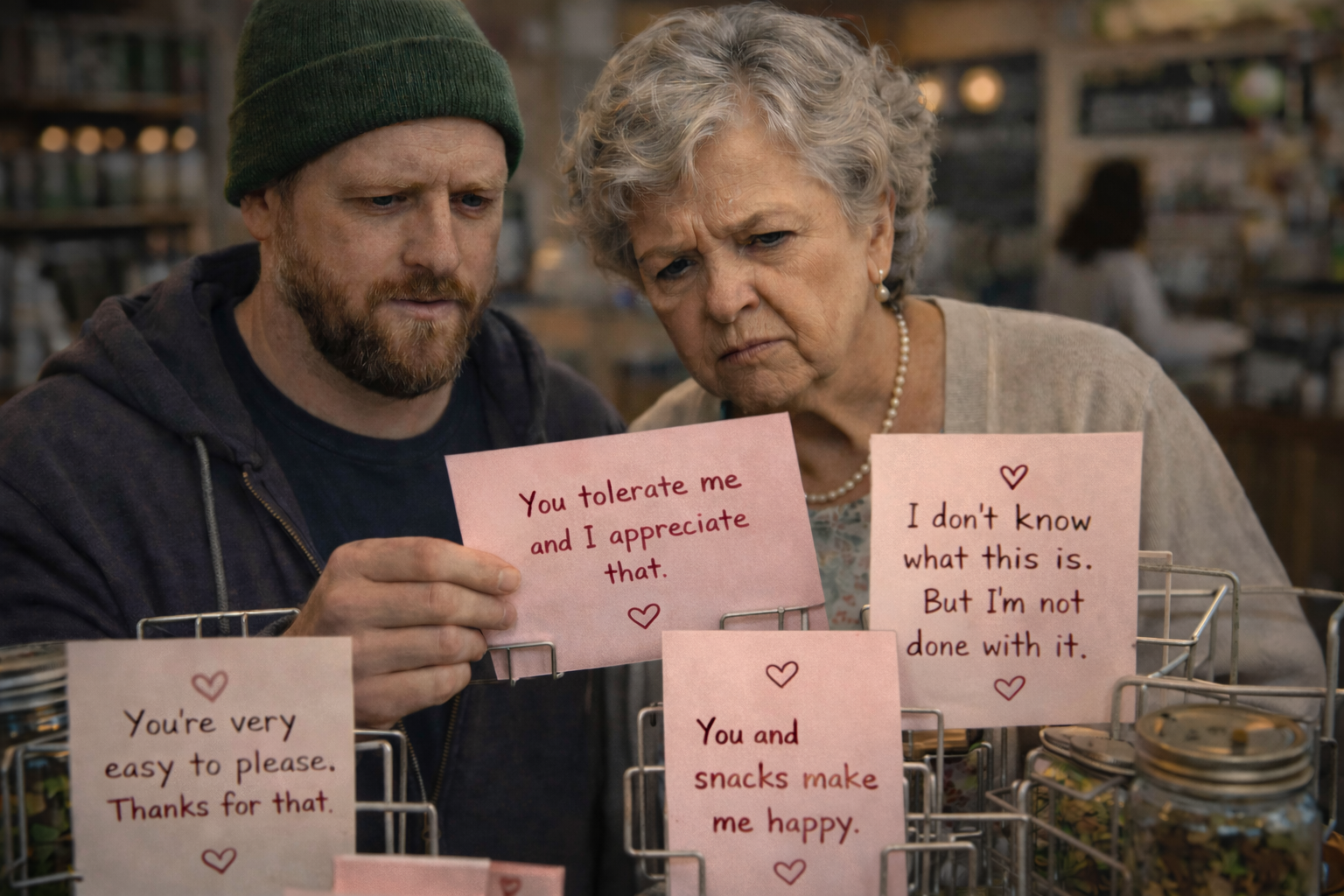
The cards showed up on a Tuesday.
No announcement.
No explanation.
Just a small wire rack near the counter that had not been there yesterday.
At first glance, it looked normal enough.
Pink cardstock. Red ink. Hearts drawn by someone who understood the idea of a heart but didn’t feel the need to perfect it.
Then people started reading them.
One said:
“I like you more than most people.
Which is saying something.”
Another:
“You’re my favorite person to be quiet with.”
Someone picked up a third card, squinted, and laughed once—short and surprised.
“Let’s not see other people.
It sounds exhausting.”
By 10:15 a.m., the rack had a crowd.
No one admitted to writing the cards.
Fern didn’t know where they came from.
Nugs said, “I wish these were mine,” which was not a denial.
A couple argued softly over one card that read:
“I love you.
I just don’t always want to talk about it.”
“That’s sweet,” one said.
“That’s alarming,” said the other.
Glady stood three feet back, arms crossed, reading every single one with visible disapproval.
“These are not romantic,” she said.
Then, after a pause:
“…That one’s accurate though.”
By noon, the rack was half empty.
People bought them “as a joke,”
or “for someone who’d get it,”
or “just in case.”
One man bought three and stood outside rereading them like he was deciding which version of himself he could live with.
A woman came back twenty minutes later and bought the same card again because,
“I didn’t like how honest it was the first time.”
Around closing, only one card remained.
It read:
“I don’t know what this is.
But I’m not done with it.”
No one bought it.
Fern left it there overnight.
Just in case.